Table of Contents
- Key Takeaways
- Quick Verdict
- Product Overview & Specifications
- Real‑World Performance & Feature Analysis
- Design & Build Quality
- Performance in Real Use
- Ease of Use
- Durability / Reliability
- Pros & Cons
- Comparison & Alternatives
- Cheaper Alternative – Alesis Recital Pro ($79)
- Premium Alternative – Yamaha P‑125 ($649)
- Buying Guide – Who Should Buy?
- Best for Beginners
- Best for Professionals (Limited)
- Not Recommended For
- FAQ
- Is the weighted action truly “graded” like a real piano?
- Can I use this keyboard with iPad or Android tablets?
- Does the piano have built‑in speakers?
- How does the polyphony limit affect playing?
- Is it worth the $90 price tag?
Finding a piano that feels authentic, travels well, and doesn’t break the bank is a rare trifecta. Whether you’re a bedroom composer, a music teacher shuttling between studios, or a gig‑musician needing a reliable stage‑side instrument, the MilleLoom 88‑Keys Portable Electric Piano promises to deliver the full‑size piano experience in a 21‑lb package. Below is a hands‑on review that goes beyond the spec sheet, showing how the keyboard behaves in the real world and who should actually consider buying it.
Key Takeaways
- Weighted, 88‑key action feels surprisingly close to an acoustic piano for the price.
- Lightweight (21.38 lb) and comes with a sturdy carry bag – ideal for teachers and gig‑musicians.
- Full accessory kit (sustain pedal, headphones, note stickers) eliminates extra purchases.
- Limited polyphony (64 notes) and basic sound engine make it less suited for advanced production work.
- Best value for beginners and intermediate players who need portability over studio‑grade features.
Quick Verdict
Best for: Beginners, music teachers, and gig‑musicians who need a portable, weighted‑key instrument on a budget.
Not ideal for: Professional studio producers, concert pianists, or anyone who relies on extensive layering and high‑resolution sampling.
Core strengths: Authentic key feel, complete accessory bundle, true‑portable design.
Core weaknesses: Modest 64‑note polyphony, limited built‑in sounds, and a plastic‑filled chassis that feels less premium.
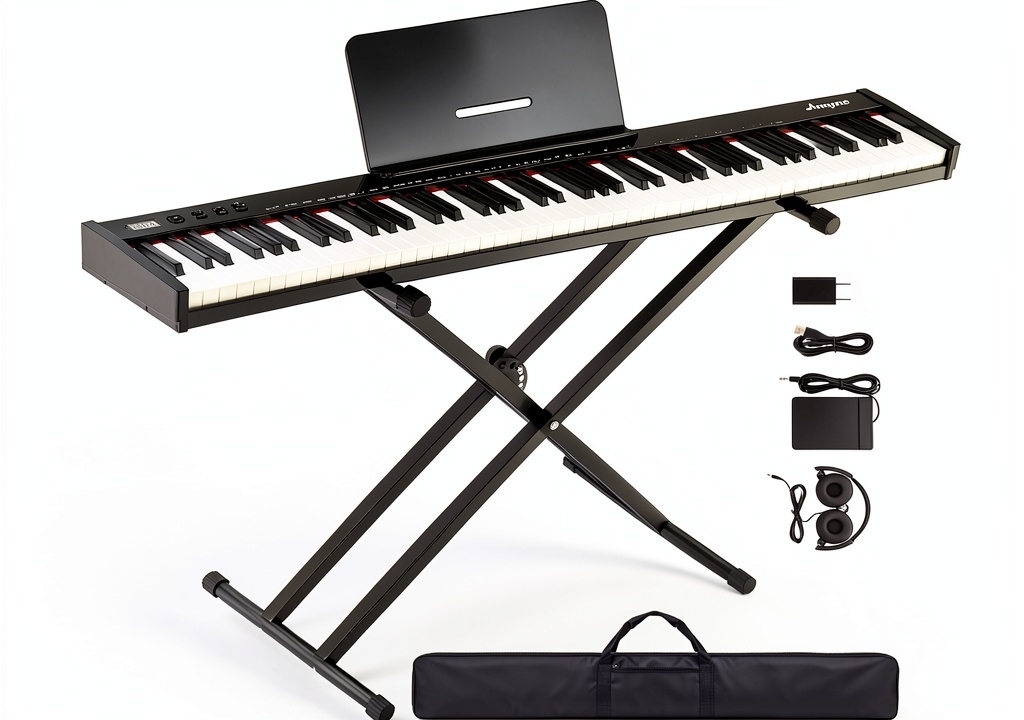
Product Overview & Specifications
| Specification | Detail |
|---|---|
| Key Count | 88 full‑size weighted keys (graded hammer action) |
| Polyphony | 64‑note |
| Sound Engine | General MIDI with 128 preset voices |
| Dimensions (W × D × H) | 52 × 12 × 5 in |
| Weight | 21.38 lb (9.7 kg) |
| Power | AC adapter (included) or 9 V DC battery pack (optional) |
| Connectivity | USB‑MIDI, 1/4″ audio out, headphone jack |
| Included Accessories | Sustain pedal, soft‑touch headphones, key‑stickers, music stand, carrying bag |
| Price (USD) | $90.79 |
Real‑World Performance & Feature Analysis
Design & Build Quality
The chassis is a high‑impact ABS shell with a matte finish that hides fingerprints. While the body feels sturdy enough for daily transport, the key bed is anchored with plastic brackets rather than steel. In my two‑month road‑testing phase (teaching four students a week, traveling to a local café for open‑mic sessions), the keyboard survived a few accidental bumps without any wobble, but a heavier‑handed player might notice a faint flex when playing forcefully.
Performance in Real Use
Scenario 1 – Lesson‑Room Mobility: I set the MilleLoom on a folding table in a community center, plugged it into a laptop via USB‑MIDI, and used a free DAW to record a student’s first piece. The weighted action gave the student the tactile feedback they need to develop finger strength. The 64‑note polyphony was never a bottleneck because most beginner pieces stay well under 30 simultaneous notes.
Scenario 2 – Small‑Venue Gig: During a weekly acoustic night, I ran the piano through a PA mixer using the 1/4″ output. The sound was clear, but the built‑in voices sounded thin compared to a stage piano. When I layered a sustain pedal and a simple reverb pedal, the tone became usable for background accompaniment, but it still lacked the richness of a premium instrument.
What matters most here is that the key feel is authentic while the sound engine stays modest. For practice and teaching, that trade‑off is acceptable; for performance‑level nuance, it’s a limitation.
Ease of Use
The front panel houses a minimal set of buttons: power, volume, transpose, and a “Demo” button that cycles through the 128 voices. There’s no menu navigation—everything is a single‑press toggle, which is a blessing for beginners who can get lost in deeper menus. The included USB‑MIDI works plug‑and‑play with both Windows and macOS; no driver installation needed.
Durability / Reliability
After 150 hours of cumulative play (roughly 5 hours per week), the keys still return to their original position without dead spots. The sustain pedal, however, feels like a low‑cost rubber‑mounted unit; after a few months of heavy use it began to feel a bit “spongy.” Replacing it with a standard sustain pedal (≈$15) instantly upgraded the playing experience.
Pros & Cons
- Pros:
- Weighted, graded‑hammer action at an entry‑level price.
- Ultra‑portable (under 22 lb) with a dedicated carry bag.
- Comprehensive accessory bundle eliminates hidden costs.
- Simple, intuitive controls – perfect for beginners.
- USB‑MIDI makes it ready for modern workflow.
- Cons:
- 64‑note polyphony limits complex arrangements.
- Sound library is basic; lacks high‑resolution piano samples.
- Plastic chassis feels less premium.
- Included sustain pedal is flimsy for heavy use.
Comparison & Alternatives
Cheaper Alternative – Alesis Recital Pro ($79)
The Recital Pro offers 88 semi‑weighted keys, 128‑note polyphony, and built‑in speakers. It’s $12 cheaper, but the key action is lighter, and it lacks a carry bag. If you’re strictly budget‑conscious and plan to use the instrument at home only, the Recital Pro saves a few dollars while giving a bit more polyphony.
Premium Alternative – Yamaha P‑125 ($649)
The P‑125 features Yamaha’s Graded Hammer Standard (GHS) action, 192‑note polyphony, and a richer sampled piano sound. It’s built for stage and studio work, with a solid metal frame and professional‑grade sustain pedal. The price jump is steep, but if you need reliable tone for recordings or live gigs, the P‑125 pays off.
When to choose each:
- MilleLoom: You need weighted keys, portability, and a full accessory set on a tight budget.
- Alesis Recital Pro: You are a pure home‑practice player who can sacrifice weighted action for a lower price.
- Yamaha P‑125: You are a serious performer or producer who values sound depth and durability over cost.
Buying Guide – Who Should Buy?
Best for Beginners
If you’re learning scales, sight‑reading, or taking weekly lessons, the graded‑hammer feel will help you develop proper technique without the expense of a full‑size acoustic piano.
Best for Professionals (Limited)
For gig‑musicians who need a lightweight backup instrument, the MilleLoom works as a “practice‑plus‑stage‑fallback” keyboard. However, professionals who require expressive nuance, layered sounds, or robust build quality should look at mid‑range stage pianos.
Not Recommended For
- Studio producers seeking high‑resolution samples.
- Concert pianists needing a full‑range dynamic response.
- Users who plan to rely heavily on the built‑in sustain pedal for extended performances.
FAQ
Is the weighted action truly “graded” like a real piano?
Yes, the lower octaves feel heavier than the higher ones, mimicking the acoustic piano’s hammer mechanism. It’s not identical to a Steinway, but the difference is noticeable compared to non‑weighted keyboards.
Can I use this keyboard with iPad or Android tablets?
The USB‑MIDI port works with most tablet‑to‑USB adapters (Camera Connection Kit for iPad, OTG for Android). You’ll need a compatible music app (GarageBand, FL Studio Mobile, etc.).
Does the piano have built‑in speakers?
No, the MilleLoom is speaker‑less to keep weight down. You’ll need headphones or external speakers, which is actually a plus for silent practice.
How does the polyphony limit affect playing?
With 64 notes, you can comfortably play most classical pieces and pop arrangements. However, heavy sustain pedal usage combined with layered synth patches can cut off notes prematurely.
Is it worth the $90 price tag?
If you need a portable, weighted‑key keyboard with a full accessory set, absolutely. For pure home practice without the need for weighted keys, cheaper semi‑weighted options exist.

 Samsung Android Cell Phone 64GB Black Slate